Birthmark Shape Meanings: Folklore and Medical Facts
What folklore says birthmark shapes and spots mean across cultures, from hearts and stars to abiku marks, plus the medical facts and when to see a doctor.
Contents
Quick answer In folklore, a heart shaped birthmark is said to mean love, a star luck, a moon intuition, a butterfly change, and a strawberry mark a mother's craving in pregnancy. These are folk beliefs, not facts. Medically, birthmarks are clusters of blood vessels or pigment cells. Most are harmless, but any mark that grows fast, bleeds or changes should be seen by a doctor.
People have always wondered why a baby is born with a mark. Before doctors could explain it, families gave birthmarks meaning: a message from God, a sign of a past life, a mother's wish, or a hint about the child's future. Many of these stories are still told today.
This page lists the most common folk meanings for birthmark shapes and places on the body, then gives the medical facts. Everything in the folklore sections is belief and tradition. None of it is proven.
Where birthmark beliefs come from
Most birthmark folklore grew from a few old ideas.
- Maternal impression. For centuries Europeans believed a pregnant woman's fright or craving could mark her baby. A red mark meant she craved strawberries or wine. In Italian a birthmark is still called una voglia, "a desire". Doctors dropped this idea long ago.
- Past life marks. In many cultures a birthmark is believed to show a wound or sign from a previous life. The psychiatrist Ian Stevenson collected cases where children's marks were said to match injuries of a person who had died. His work is widely debated and not accepted as proof.
- Spirit children. In Yoruba belief an abiku, and in Igbo belief an ogbanje, is a child believed to die and return to the same mother. Accounts describe families marking a child who died, then looking for the same mark on the next baby.
- Divine or evil signs. Some saw birthmarks as a blessing or "angel's kiss". During the European witch trials, by contrast, unusual marks were wrongly treated as a "devil's mark", which led to great harm.
Birthmark shape meanings in folklore
Shape meanings are mostly modern popular beliefs, passed on by word of mouth and online. There is no single tradition behind them, and different sources disagree.
| Shape | Common folk meaning |
|---|---|
| Heart | A loving nature, or a love carried from a past life |
| Star | Good luck, a bright future or a special purpose |
| Moon or crescent | Intuition, a dreamer, a deep spiritual life |
| Butterfly | Change, growth and a fresh start |
| Cross | Faith, protection or a calling to serve God |
| Bird or wing | Freedom, travel, a free spirit |
| Circle or round spot | Completeness, balance or a strong family bond |
| Strawberry or berry | A mother's craving in pregnancy, or a sweet nature |
| Map or island shape | A traveller who will live far from home |
| Line or streak | An old wound from a past life, or a path the person must follow |
Birthmark location meanings in folklore
Where the mark sits is often given more meaning than its shape. These are common beliefs, not facts.
- Face: beauty, charm or being noticed. A mark near the mouth is said to mean a good talker.
- Forehead: wisdom, leadership or a special calling. Salmon patches here are often called "angel kisses".
- Back of the neck: often called a "stork bite" in English, linked in stories to the stork that delivers babies.
- Chest: a warm heart and love for family.
- Back: loyalty and honesty, or in some past life stories, an old wound.
- Right hand or arm: hard work, skill and money earned with the hands.
- Left hand or arm: creativity and a giving nature.
- Stomach: love of good food and comfort, or a nurturing spirit.
- Legs and feet: travel and a restless spirit. A mark on the foot is said to mean you will see the world.
- Buttocks: a mark of luck in some homes, often a harmless blue patch common in African and Asian babies.
What are birthmarks medically?
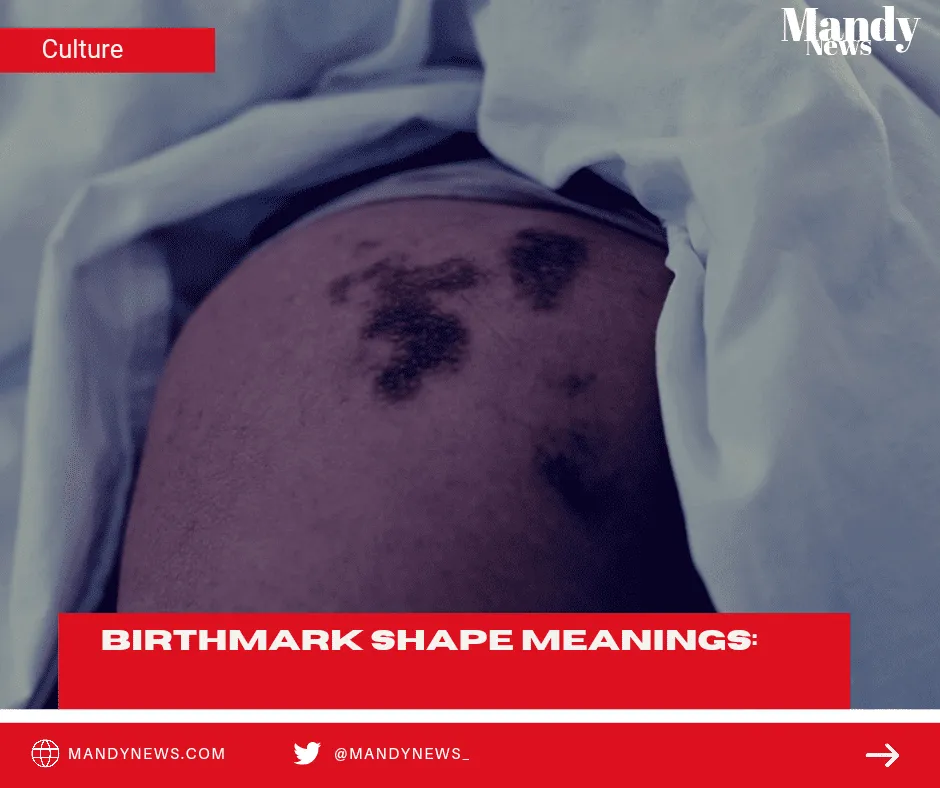
A birthmark is a coloured mark on the skin present at birth or soon after. Doctors put them in two groups: vascular marks, made of blood vessels, and pigmented marks, made of clusters of the cells that give skin its colour. Most are harmless.
Vascular birthmarks
- Salmon patch (stork bite, angel kiss): flat pink marks on the forehead, eyelids or back of the neck. Very common, and most fade as the child grows.
- Infantile haemangioma (strawberry mark): a raised red lump that often appears in the first weeks of life, grows quickly, then slowly shrinks over years. About 1 in 10 babies has one.
- Deep haemangioma: sits lower in the skin and looks bluish and spongy. Many shrink on their own.
- Port wine stain: a flat pink, red or purple mark, often on the face. It does not fade on its own and may darken or thicken with age. Laser treatment can lighten it.
Pigmented birthmarks
- Congenital dermal melanocytosis (once called Mongolian spot): flat blue grey patches, usually on the lower back and buttocks. Very common in babies with darker skin and often mistaken for bruises.
- Café au lait spots: light brown oval patches. One or two are normal. Many spots can point to a genetic condition called neurofibromatosis and should be checked.
- Congenital moles (naevi): brown or black moles present at birth, in about 1 in 100 people. Large ones carry a higher risk of skin cancer and need regular checks.
When to see a doctor about a birthmark
Most birthmarks need nothing, but have one checked if any of these happen.
- It grows quickly, especially in a young baby
- It bleeds, forms a sore, or becomes painful or infected
- It sits near the eye, nose, mouth or nappy area
- A mark near the eye blocks or affects the baby's vision, since this can lead to lazy eye
- A mole changes in colour, size, shape or texture
- The child has many café au lait spots
- A large port wine stain is on the face, especially around the eye
- A new mark appears in an adult
If a haemangioma bleeds, press on it with a clean cloth for five minutes. If bleeding does not stop, go to a hospital.
A birthmark is never a reason to fear or reject a child. Teasing about marks can hurt, so it helps to give children a simple, kind explanation they can share.
Frequently asked questions
What does a heart shaped birthmark mean?
In folklore it is said to mean a loving nature or a love carried from a past life. Medically it is an ordinary birthmark that happens to be heart shaped.
Are birthmarks signs of a past life?
Some cultures and researchers believe so, but there is no accepted scientific proof. Doctors explain birthmarks by how blood vessels and pigment cells form before birth.
Does a mother's craving cause a birthmark?
No. This was an old European belief, but birthmarks are not caused by anything the mother ate, wanted or saw during pregnancy.
Which birthmarks are dangerous?
Most are harmless. Large congenital moles, marks near the eye, fast growing haemangiomas and many café au lait spots should be checked by a doctor.
Can birthmarks be removed?
Some can be treated with laser, medicine or surgery, depending on the type. Many fade on their own, so a doctor will advise whether treatment is needed.
Is a blue birthmark on my baby's bottom normal?
Yes, flat blue grey patches on the lower back and buttocks are very common in African babies and are harmless. Show any new mark to your doctor if you are unsure.
Questions from readers
No questions yet. Ask the first one.