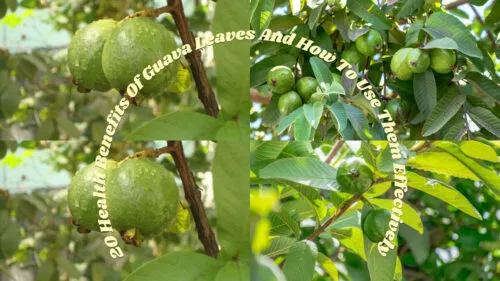
Health Benefits of Guava Leaves: What the Research Shows
Small trials suggest guava leaves lower blood sugar after meals and ease period pain. Other claims are lab only. How to make the tea, who should avoid it.
Contents
Quick answer Guava leaves are rich in plant compounds called polyphenols. Small human studies suggest guava leaf tea can blunt the rise in blood sugar after a meal, and one trial found a guava leaf extract eased period pain. Most other claims (immunity, hair, weight loss, cancer) come from lab or animal studies only. The tea is a helper, not a cure.
Guava (Psidium guajava) grows in almost every compound in Nigeria and Ghana, and many families already boil the leaves for stomach upset or "sugar". Science has looked at the leaves more than most local herbs, so we can say fairly clearly what is backed by evidence and what is still hope.
Below, each benefit is graded by the kind of research behind it: lab (test tube or cells), animal (rats, mice) or human trial (real people). Only human trials tell you what happens in your body.
Guava leaves benefits: what the research shows
The strongest human evidence is for blood sugar after meals and for period pain. Everything else is early.
| Claimed benefit | Type of evidence | How strong |
|---|---|---|
| Lower blood sugar after meals | Several small human trials, mostly in Japan | Moderate, short term |
| Less period pain | One randomised human trial (197 women) | Promising, needs repeating |
| Diarrhoea relief | One small trial in infants, plus animal studies | Weak, mixed |
| Cholesterol | Small human and animal studies | Weak |
| Fights germs, antioxidant | Lab studies | Lab only |
| Cancer, hair growth, weight loss | Lab and animal, or none | Not proven |
1. Blood sugar after meals (human trials)
In Japan, a guava leaf tea sold by Yakult under the name Bansoureicha is approved as a Food for Specified Health Uses for people with pre-diabetes. A review by Deguchi and Miyazaki in Nutrition and Metabolism (2010) gathered the studies behind it. In small trials, people who drank the tea with a starchy meal had a smaller rise in blood sugar afterwards. The leaves seem to slow the gut enzymes that break starch and sugar into glucose.
What this does not mean: guava leaf tea does not cure diabetes and cannot replace your drugs. The trials were small and short. If you take metformin, insulin or other sugar drugs, adding the tea could push your sugar too low, so tell your doctor and check your readings.
2. Period pain (one human trial)
A double blind trial in Mexico (Doubova and others, Journal of Ethnopharmacology, 2007) gave 197 young women with painful periods a standardised guava leaf extract, ibuprofen or a dummy pill. The group on 6 mg a day of the extract had significantly less pain, and the authors reported it did better than both ibuprofen and placebo. The lower dose did not work consistently. This was a measured extract in capsules, not home tea, so the dose in a cup of boiled leaves is unknown.
3. Diarrhoea (weak, mixed)
Guava leaf is one of the oldest folk remedies for running stomach in West Africa, Asia and Latin America. A Chinese trial of 62 infants with rotavirus diarrhoea reported faster recovery with a guava leaf preparation, but it compared guava with another herbal mix, not with standard treatment. A 2025 rat study found no clear anti-diarrhoea effect. For diarrhoea, oral rehydration solution (ORS) and zinc remain the proven treatment, especially for children.
4. Antioxidant and antibacterial effects (lab only)
Guava leaf extracts kill some bacteria and fungi in the lab and are rich in antioxidants such as quercetin. That is why some people use cooled tea as a mouthwash or a wash for small skin spots. Lab results do not prove the same effect inside the body.
5. Cholesterol, cancer, hair and weight loss (not proven)
Some animal studies show lower cholesterol, and cell studies show effects on cancer cells. There are no good human trials showing guava leaves treat cancer, grow hair or melt fat. Be careful with anyone selling guava leaf as a cure for these.
How to make guava leaf tea
Use young, clean leaves from a tree that has not been sprayed. A gentle home brew is enough.
- Pick 5 to 8 young leaves and wash them well.
- Boil about two cups of water.
- Add the leaves, lower the heat and simmer for 5 to 10 minutes.
- Strain and let it cool to a drinkable warmth.
- Drink one cup, ideally with or after a meal if your aim is blood sugar.
Dried leaves work too: about one teaspoon of crushed dry leaf per cup. Keep it to one or two cups a day. More is not better.
What you need
- 5 to 8 fresh young guava leaves, or 1 teaspoon dried leaf
- 2 cups of clean water
- A pot and a strainer
- Lemon, optional (skip honey and sugar if you are watching your blood sugar)
Guava leaves side effects and who should avoid them
As a weak tea in normal amounts, guava leaf seems well tolerated in the human studies, but long term safety has not been well tested.
- Pregnant women: avoid. A 2024 mouse study (Tropical Journal of Natural Product Research) found lower foetal weight and bleeding in foetal tails and limbs with leaf extract. Mice are not people, but there is no human safety data to reassure you. The fruit itself is a normal food.
- Breastfeeding mothers: safety is unknown, so ask your doctor or midwife first.
- People on diabetes drugs: risk of low blood sugar. Monitor closely.
- Children: never use the tea in place of ORS for diarrhoea.
- Anyone with constipation: the leaves are astringent and may make it worse.
This is general information, not medical advice. If you are unwell, have diabetes or are pregnant, see a doctor or pharmacist before using any herb.
Guava leaves for fertility and other uses
Many people online say guava leaves boost sperm or balance hormones. The evidence is a handful of rat studies with mixed results and no human trials. We look at it honestly in guava leaves and ginger for fertility. For other leaves people use at home, see benefits of miracle leaf and scent leaf water.
Frequently asked questions
Is it safe to drink guava leaf tea every day?
For most healthy adults, one or two cups a day appears safe in short studies. Long term daily use has not been well studied, so take breaks and stop if you notice stomach upset.
Can guava leaves cure diabetes?
No. Small trials show the tea can reduce the rise in blood sugar after a meal, but it does not cure diabetes or replace medicine.
Do guava leaves help with weight loss?
There is no good human evidence that guava leaves cause weight loss. Any small effect would come from slowing sugar absorption, not burning fat.
Can a pregnant woman drink guava leaf tea?
It is best avoided. Animal research raised concerns about harm to the unborn baby and there is no human safety data. Eating the fruit is fine.
What is the best time to drink guava leaf tea?
The blood sugar studies gave the tea with meals, so with or just after food makes sense. For period pain, the trial used capsules, not tea.
Are guava leaves good for hair?
People rinse hair with guava leaf water, but no clinical study shows it stops hair loss or makes hair grow.
Questions from readers
No questions yet. Ask the first one.