World Cup 2026 Album: Artists, Songs and Who Got Paid
Every artist on the FIFA World Cup 2026 album, who sang at the ceremonies and halftime show, and what is actually known about pay, Burna Boy included.
Contents
- Which artists are on the official FIFA World Cup 2026 album?
- What was the official song of the 2026 World Cup?
- Who performed at the World Cup 2026 opening ceremonies?
- Who performed at the World Cup 2026 final halftime show?
- Were the artists paid for the World Cup 2026 halftime show?
- How much was Burna Boy paid for the World Cup?
- How much was Davido paid for the World Cup?
- How much was Shakira paid for the World Cup song?
- How do artists earn from World Cup songs?
- Frequently asked questions
Quick answer FIFA has not disclosed what any artist was paid for World Cup 2026 music. The official song, "Dai Dai" by Shakira and Burna Boy, sends its royalties to the FIFA Global Citizen Education Fund, and outlets reported that the final's halftime stars, Burna Boy among them, performed without a fee. No fee for Burna Boy has ever been confirmed for any World Cup.
The 2026 World Cup ran from 11 June to 19 July across the United States, Canada and Mexico. It came with more music than any World Cup before it: an official song, an 18 track album, three opening ceremonies and the first ever halftime show at a World Cup final.
People keep searching for one thing above all: how much the artists were paid. Below is what is confirmed, what was only reported, and what is just rumour.
Which artists are on the official FIFA World Cup 2026 album?
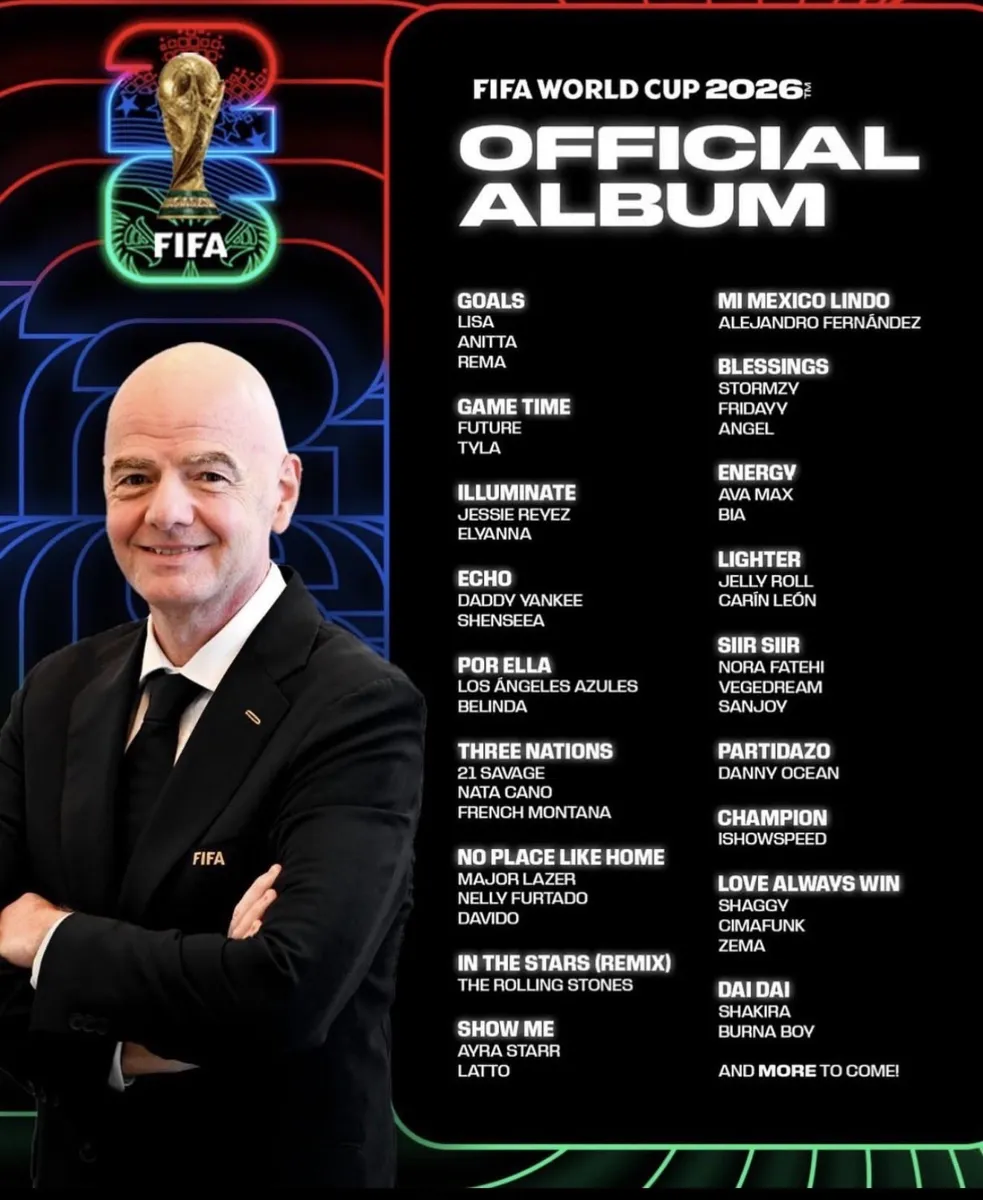
FIFA revealed the full lineup on 3 June 2026 and the album came out on 5 June through SALXCO UAM and Def Jam Recordings. Universal Music says it has 18 tracks and 45 artists, with producers including Cirkut and Tainy.
| Track | Artists |
|---|---|
| Goals | LISA, Anitta, Rema |
| Game Time | Future, Tyla |
| Illuminate | Jessie Reyez, Elyanna |
| Echo | Daddy Yankee, Shenseea |
| Por Ella | Los Ángeles Azules, Belinda |
| Three Nations | 21 Savage, Nata Cano, French Montana |
| No Place Like Home | Major Lazer, Nelly Furtado, Davido |
| In the Stars (Remix) | The Rolling Stones |
| Show Me | Ayra Starr, Latto |
| Mi Mexico Lindo | Alejandro Fernández |
| Blessings | Stormzy, Fridayy, Angel |
| Energy | Ava Max, BIA |
| Lighter | Jelly Roll, Carín León |
| Siir Siir | Nora Fatehi, Vegedream, Sanjoy |
| Partidazo | Danny Ocean |
| Champion | IShowSpeed |
| Love Always Wins | Shaggy, Cimafunk, Zema |
| Dai Dai | Shakira, Burna Boy |
Four Nigerians are on it: Burna Boy, Davido, Rema and Ayra Starr. Neither FIFA's announcement nor the label's release says anything about fees, royalty splits or where album income goes.
What was the official song of the 2026 World Cup?
"Dai Dai" by Shakira and Burna Boy. It was released on 15 May 2026, and FIFA said royalties from the song would support the FIFA Global Citizen Education Fund, according to NPR.
- It mixes Afrobeats and Latin pop, sung mostly in English with some Spanish.
- NPR counts it as Shakira's fourth song tied to a World Cup, after "Hips Don't Lie" at the 2006 closing ceremony, "Waka Waka" in 2010 and "La La La" in 2014.
- Billboard reported it reached No. 1 on the Billboard Global 200 on the chart dated 18 July, the first official World Cup anthem to top that chart. It was still No. 1 there at the end of August.
- It was Burna Boy's first No. 1 on the Global 200 as a lead artist.
Who performed at the World Cup 2026 opening ceremonies?
There were three. Shakira and Burna Boy performed "Dai Dai" at the first one, at Estadio Azteca in Mexico City on 11 June, before Mexico played South Africa.
- Mexico City, 11 June: Shakira and Burna Boy, with J Balvin, Andrea Bocelli and EJAE among the other performers reported on the day.
- Toronto, 12 June: announced acts included Alanis Morissette for Canada's anthem, Michael Bublé, Alessia Cara and Jessie Reyez.
- Los Angeles, 12 June: Katy Perry, Future, Anitta, LISA, Rema and Tyla were announced as headliners before USA played Paraguay.
The Toronto and Los Angeles lists come from pre-event announcements, so the final running order may have differed slightly. No performer fee for any of the three ceremonies has been published.
Who performed at the World Cup 2026 final halftime show?
Madonna, Shakira, BTS, Justin Bieber and Burna Boy. The final was played on 19 July at MetLife Stadium in New Jersey, and the 11 minute show was the first halftime show in World Cup history.
- FIFA and Global Citizen announced it on 14 May 2026, with Madonna, Shakira and BTS as co-headliners and Coldplay's Chris Martin as curator.
- NBC's recap lists Madonna singing "Music", BTS doing "Dynamite", Justin Bieber, and Shakira with Burna Boy on "Dai Dai", plus a children's choir and Muppets characters.
- Before kick off, Post Malone, Robbie Williams and IShowSpeed performed and Jennifer Hudson sang the US anthem.
Were the artists paid for the World Cup 2026 halftime show?
Reports say no. beIN Sports reported that the artists did not receive any payment and instead gave their time to Global Citizen, following the Super Bowl model.
Here is how the facts stack up:
- Confirmed by FIFA and Global Citizen: the show supported the FIFA Global Citizen Education Fund, which aims to raise USD 100 million for education and football for children, and USD 1 from every ticket sold for World Cup 2026 matches went to the fund.
- Reported, not in the official release: that the performers were unpaid. The Global Citizen press release itself does not mention artist pay either way.
- Rumour: viral posts claiming Madonna got USD 3 million or that BTS got a similar sum. No outlet confirmed these, and they clash with the reports that the show was unpaid.
Unpaid does not mean nothing in return. Production, travel and staging are normally covered by the organiser, and the exposure is huge. Those costs have not been published.
How much was Burna Boy paid for the World Cup?
No figure exists in any official or credible source. FIFA, Burna Boy and his team have never announced a World Cup fee.
- "Dai Dai": FIFA said the song's royalties go to the Education Fund, so the usual royalty income from the official song was pointed at charity.
- Opening ceremony in Mexico City: no fee published.
- Final halftime show: reported as unpaid, a donation of time to Global Citizen.
- Before 2026: Burna Boy did not perform at the 2022 World Cup in Qatar.
If you saw "Burna Boy paid USD 2 million" online, it most likely traces to a 2023 Nigerian report about a different event: the UEFA Champions League final kick off show in Istanbul on 10 June 2023. That figure was never confirmed by UEFA or his team, and it has nothing to do with FIFA.
How much was Davido paid for the World Cup?
Not disclosed, for 2022 or 2026. Davido sang the Qatar 2022 song "Hayya Hayya (Better Together)" with Trinidad Cardona and Aisha at the closing ceremony at Lusail Stadium on 18 December 2022, but no fee was ever reported.
For 2026 he appears on "No Place Like Home" with Major Lazer and Nelly Furtado. Again, no fee or royalty split has been made public.
How much was Shakira paid for the World Cup song?
No fee has ever been published for any of her World Cup songs. Her 2010 song "Waka Waka" is the best documented case, and it shows how murky this money can be.
Royalties from "Waka Waka" were meant to go to African charities. In 2025, Freshlyground, the South African band on the track, said publicly that they still did not know which charities had benefited. Their manager told EWN he was told the money went to FIFA for its "20 Centres for 2010" campaign, which appears to have wound down in 2014. FIFA and Sony have not published a full account.
How do artists earn from World Cup songs?
Mostly through rights and exposure, not a public fee. The money can come from these places:
- A fee or advance agreed privately with FIFA or the label. None has been disclosed for 2026.
- Streaming and sales royalties on the recording. For "Dai Dai", FIFA pointed these to charity.
- Songwriting and publishing income for whoever wrote the song.
- Exposure: billions of viewers, chart runs and bigger tour demand afterwards. This is the part that is easiest to see and hardest to price.
Anyone quoting an exact figure for a 2026 World Cup artist is guessing unless they can point to FIFA, the artist, or a signed contract.
For more on Nigerian pop culture, see our guide to Nigerian slangs and their meaning and other explainers in Meanings.
Frequently asked questions
How much did FIFA pay Burna Boy?
No amount has been disclosed. FIFA said "Dai Dai" royalties go to the FIFA Global Citizen Education Fund, and the halftime show was reported as unpaid.
Did Burna Boy perform at the 2026 World Cup?
Yes. He sang "Dai Dai" with Shakira at the opening ceremony in Mexico City on 11 June and again at the final's halftime show on 19 July.
Was Burna Boy at the 2022 World Cup in Qatar?
No. Davido was the Nigerian star at Qatar 2022, singing "Hayya Hayya" at the closing ceremony.
Who sang the official 2026 World Cup song?
Shakira and Burna Boy, with "Dai Dai", released on 15 May 2026.
How many songs are on the FIFA World Cup 2026 album?
18 tracks featuring 45 artists, released on 5 June 2026.
Did Madonna get USD 3 million for the halftime show?
That figure was a social media rumour. Reports after the show said the performers were not paid and donated their time to Global Citizen.
Questions from readers
No questions yet. Ask the first one.