I Almost Got Killed Over Eight Hundred Naira: Why I Am Building Abeg Na
At the time, I was in my twenties, running my third media startup — a fact-checking and reporting platform. Back when fact-checking was still a novel concept in…
 Collins Asein· · Updated 22 October 2026 · 7 min read
Contents
My Life Was Valued at Eight Hundred Naira
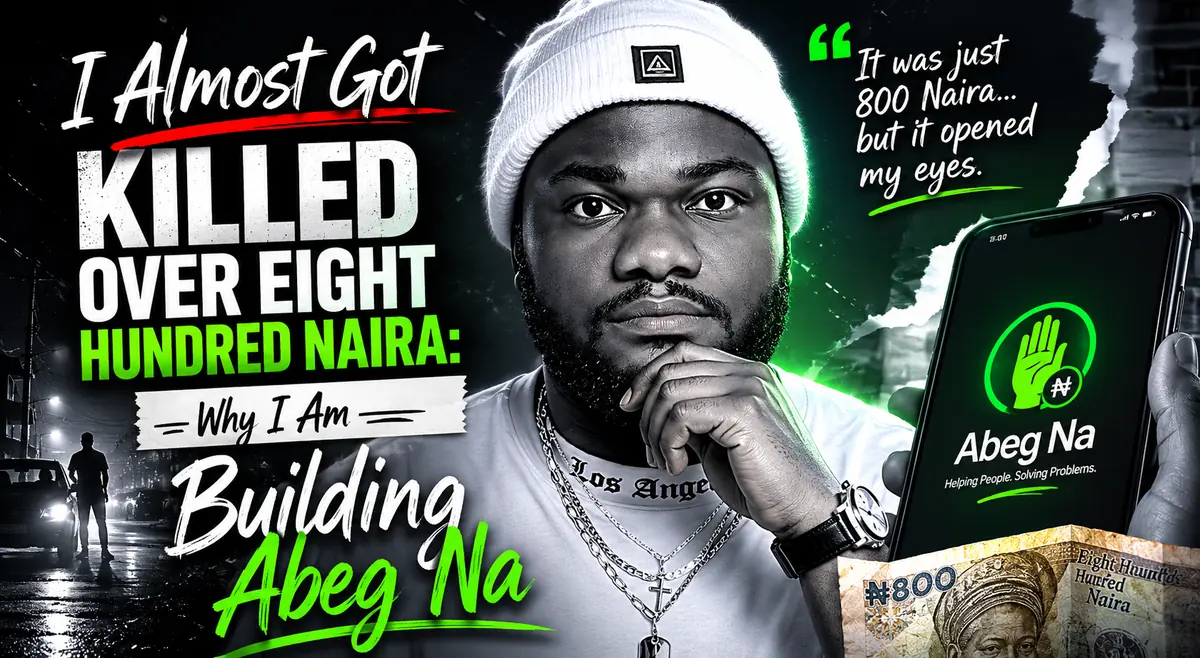
In 2019, my life was valued at exactly eight hundred naira.
At the time, I was in my twenties, running my third media startup — a fact-checking and reporting platform. Back when fact-checking was still a novel concept in Nigeria, I was tracking down fake news, bringing truth to online spaces, and making a decent living doing what I loved. When it comes to almost killed over, this is a key consideration.
To unplug from the constant notifications and the non-stop grind, I decided to take a short trip to the Babalola mountain prayer grounds in southwestern Nigeria. It was a place to fast, pray, and completely disconnect. No internet, no notification pings, just isolation. When it comes to almost killed over, this is a key consideration.
Before leaving, I had opened a new account with Keystone Bank. What the bank agents failed to tell me — and what was buried in the fine print — was that this account came with a strict credit limit of twenty thousand naira. While I was on the mountain, a deposit came in that pushed my balance past that limit. Automatically, without my knowledge, the bank froze my account.
What Happened at the Ibadan Bus Park
On my way back, I stopped at the only ATM in Efon Alaaye — an ancient town nestled in the Ekiti hills — to withdraw cash for my journey. My card bounced.
This was 2019. Point-of-Sale (POS) agents were not on every street corner like they are today. If an ATM in a rural town said “No,” your financial options evaporated. Assured that it was just a localized network glitch, I boarded a commercial bus heading to Ibadan.
My plan was simple: the moment the bus arrived in Ibadan, I would step off, use the first functioning ATM I saw to get cash, and pay the driver my fare. I had done this before; it never felt like a risk.
When we arrived at the Ibadan under bridge transit hub — a chaotic, loud, and unforgiving environment — I tried the ATM. It rejected my card once, then twice. Panic set in. I checked my phone and finally realized my account had been frozen.
I owed the driver exactly eight hundred naira. Less than one United States dollar.
When I tried to explain the bank freeze to the driver, his face hardened. He did not see a young entrepreneur dealing with an administrative banking error; he saw a thief. He called out to the local touts under the bridge. Within seconds, a mob formed.
They started beating me. Punching, kicking, pulling my clothes, dragging me onto the asphalt. I was bleeding. These were not hardened criminals; they were ordinary citizens who had decided that a man who could not pay an eight hundred naira bus fare deserved whatever violence the street chose to hand him. Under a mob, time loses all meaning. I did not know if I would survive the next minute, let alone make it home.
Then, a Miracle Walked By
A woman passing through the chaotic terminal noticed the plastic gallon of water in my hand — a gallon of holy water I had carried down from the prayer mountain. She recognized the symbol, stopped the mob, and listened to my cracking voice. She believed me.
She turned to the driver, opened her purse, and handed him the eight hundred naira. Just like that, the mob dispersed, the driver walked away, and my life was saved by a stranger who owed me absolutely nothing.
I was shaking, bleeding, and barely standing. I asked for her bank account details. Once I managed to reach a phone, I called my sister, who immediately transferred five thousand naira to the woman’s account as a token of my eternal gratitude.
The Night I Slept on Cold Concrete in Mararaba
Years later, I found myself stranded again.
I had traveled to Abuja for a visa collection. The embassy processing took days longer and cost significantly more than I had budgeted, leaving me entirely empty-handed by nightfall.
I ended up in Mararaba, on the outskirts of Abuja, unable to afford even the cheapest, most basic lodging for the night. I dialed contact after contact. Some did not pick up; others simply did not have the cash to spare late at night. There was no platform, no digital avenue where I could post my urgent need for just five thousand naira to sleep under a secure roof.
I spent that night sleeping on the cold, bare concrete outside.
As I lay there, looking at the dark sky, a profound realization hit me: within a one-mile radius of where I slept, there were likely thousands of kind, generous Nigerians who had five thousand naira to spare and would have happily paid for my room if they had only known I was stranded.
The Real Problem: A Lack of Connection
The fundamental problem in Nigeria has never been a lack of generosity. The World Giving Index consistently ranks Nigerians among the most generous people on earth. We are a people of deep empathy, bound by communal ties.
The problem is a total lack of connection.
There is a massive digital and physical chasm separating:
- The person who needs three thousand naira for emergency malaria medication tonight
- From the millions of remote helpers who would gladly send five hundred naira to save them if they only knew they existed
The woman at the Ibadan bus park could only rescue me because she happened to be physically standing right next to me. What about the helpers who are miles away?
Introducing Abeg Na
I am building Abeg Na (abegna.com) to bridge this exact chasm.
“Abeg na” is a phrase every single Nigerian knows. In our local parlance and Nigerian Pidgin, it is a deeply human, culturally neutral plea of hope and vulnerability used when all other options have been exhausted. By transforming this everyday phrase into a structured digital platform, we are stripping away the social stigma of asking for help. We are replacing shame with community, dignity, and organized digital support.
Abeg Na is not a commercial loan app. There are no interest rates, no humiliating debt collection practices, no complex credit scores, and no repayments. It is Nigeria’s first dedicated, direct peer-to-peer micro-giving platform.
How Abeg Na Works {#how-it-works}
We have designed every single feature of the platform around the lessons of speed, safety, and human dignity.
1. Strict Micro-Giving Limits (2,000 NGN to 30,000 NGN)
The emergencies that threaten lives in Nigeria are rarely massive institutional debts; they are localized cash crunches — 3,000 naira for medicine, 2,000 naira for transit fare, or 5,000 naira for emergency food. By capping requests at 30,000 naira, we keep the platform focused entirely on survival needs while naturally deterring sophisticated digital fraud syndicates who seek higher payouts.
2. Ultra-Fast, Low-Friction Signups
During an active crisis, you do not have the time to type in passwords, verify emails, or fill out lengthy forms. Abeg Na replaces this friction with simple, single-factor phone number verification. Since phone numbers in Nigeria are biometrically tied to National Identification Numbers (NIN), we maintain a secure, accountable network without slowing down your access to help.
3. No Middlemen, No Bureaucracy
We connect donors directly to recipients. There are no NGO administrative fees, no political gatekeepers, and no delays. Donors can browse verified, active micro-requests and contribute small, manageable amounts — 100, 500, or 2,000 naira — directly to the person in need.
4. 5-Minute Paystack Withdrawals
When an emergency strikes, speed is everything. The moment your request is funded, you can withdraw your money immediately. Our backend is integrated directly with Paystack, guaranteeing that funds land securely in any local bank account within five minutes.
5. A Flat 100 NGN Processing Fee
We refuse to take a percentage cut of your emergency donations. To keep the platform sustainable and operational, Abeg Na charges a flat processing fee of only one hundred naira per successful withdrawal.
Join the Waitlist
Abeg Na is officially scheduled to launch in the second quarter of 2026.
Starting today, we are opening the official digital waitlist to the world at abegna.com.
Whether you are:
- A donor looking for a transparent, immediate way to change a life with the loose change in your account, or
- Someone who wants to secure a financial safety net for life’s unexpected emergencies
There is a place for you here.
No Nigerian should ever have to face violence, sleep on cold concrete, or suffer a health crisis because they lack access to a small amount of cash. Let us build the digital bridge that connects our collective generosity to the people who need it most.
👉 Join the waitlist today at abegna.com and help us unveil a safer, more compassionate Nigeria.
Was this story helpful? Share it with someone who believes in the power of community.
Questions from readers
No questions yet. Ask the first one.